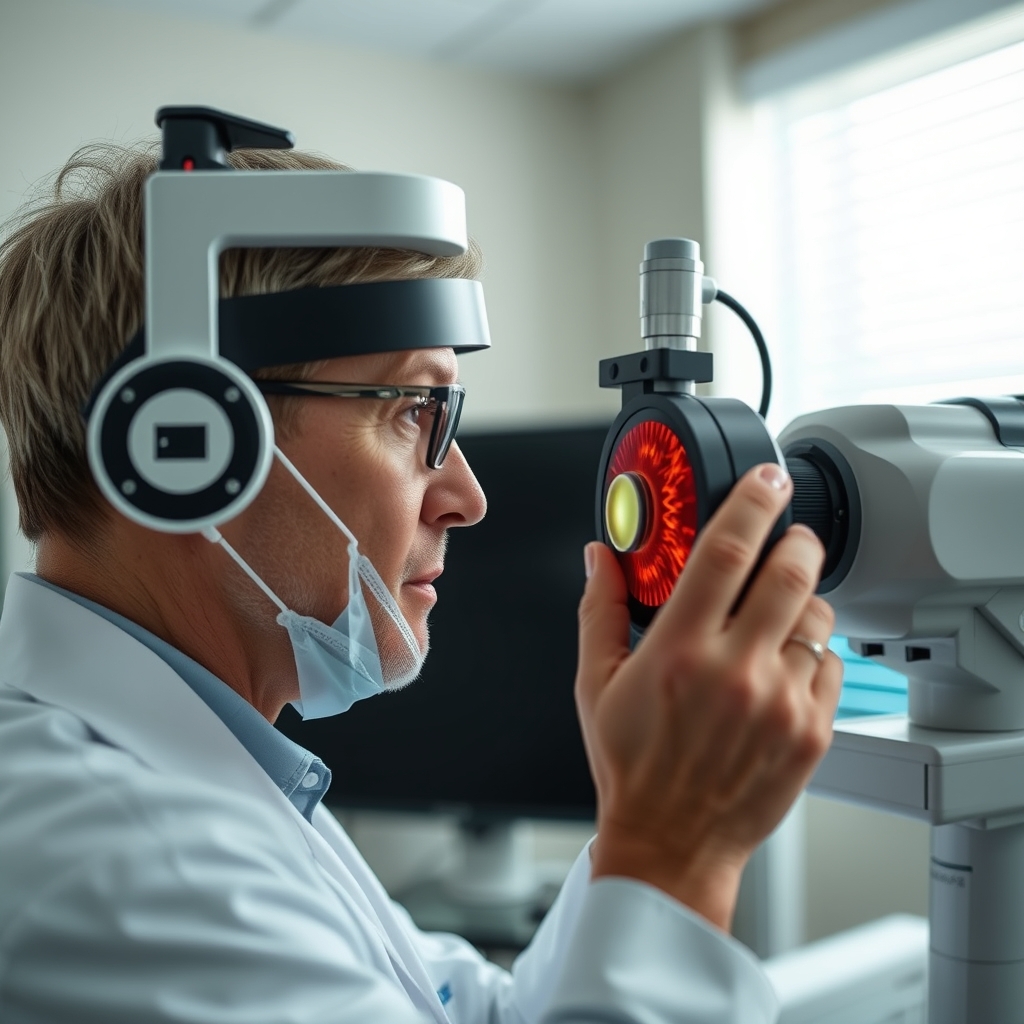
Wireless Retinal Implant Demonstrates Three-Year Control of Geographic Atrophy
A wireless photovoltaic subretinal implant has demonstrated durable control of vision loss caused by advanced geographic atrophy for up to three years, according to data presented at the American Academy of Ophthalmology annual meeting. Researchers reported that improvements in visual acuity were sustained through 36 months of follow-up among participants in a pivotal single-arm trial.
Understanding the PRIMA System Technology
The device, known as the PRIMA system, is designed to replace lost photoreceptor function in patients suffering from advanced geographic atrophy, a severe form of age-related macular degeneration. The technology utilizes a tiny wireless subretinal implant alongside specialized augmented-reality glasses. A miniature camera mounted on the glasses captures a live visual feed, which is then processed and converted into pulsed near-infrared light. This light travels through the pupil to the implant, where it is converted into an electrical current that stimulates adjacent retinal cells to mimic natural signaling pathways to the brain.
Trial Findings and Visual Acuity Gains
The findings stem from the PRIMAvera trial, a phase III-equivalent study that enrolled 38 participants across 17 clinical sites in Europe. Out of the original cohort, 27 patients successfully completed the 36-month assessment period. Presenting investigator Ehsan Rahimy, MD, of Stanford Medicine, reported that visual acuity improvements averaged negative 0.59 logMAR at 36 months, translating to a gain of approximately 30 letters. This represented an incremental visual improvement of about five letters compared to results measured at the 12-month mark.
Furthermore, trial data indicated functional improvements in daily activities. Between 24 and 36 months, half of the evaluated patients reported an increased ability to perform complex tasks such as reading menus, operating smartphones, and playing cards. Meanwhile, untreated fellow eyes lost an average of 1.4 lines of vision over the same duration, while untreated eyes in patients with the device maintained stable baseline vision.
Safety Profile and Expert Perspectives
Investigators documented 29 serious adverse events over the course of the 36-month study, with the vast majority occurring within the first six months following the surgical procedure. The most frequently observed complications included hypotony, subretinal hemorrhage, minor retinal tears, and macular holes. Dr. Rahimy noted that serious adverse events were front-loaded due to the nature of the surgery and did not restrict potential visual gains or compromise natural baseline vision.
Independent experts noted both encouraging aspects and areas requiring further observation. Joan Miller, MD, of Mass General Brigham, who was not involved in the research, highlighted the study’s high mortality rate, noting that seven participants died during the trial. Dr. Rahimy explained that the deaths were unrelated to the surgical procedure or the implant itself, reflecting the advanced age and end-stage status of the study population, which had a mean age of nearly 79 years. Additionally, four participants dropped out due to relocation or inability to continue required follow-up visits.
Study Limitations and Next Steps
Because the trial was a single-arm study without a concurrent control group, experts emphasized the need for comparative data to better contextualize outcomes within this specific patient demographic. Furthermore, researchers pointed out that successful utilization of the device requires a rigorous postoperative rehabilitation program, as patients must train themselves to interpret the visual signals provided by the implant. The manufacturer, Science Corporation, is currently preparing to pursue regulatory approval from the U.S. Food and Drug Administration following the device’s recent approval in Europe.
- The PRIMA system is a wireless subretinal implant designed to restore central vision in geographic atrophy patients.
- At 36 months, trial participants gained an average of about 30 letters in visual acuity.
- Serious adverse events were primarily concentrated in the first six months post-surgery.
Source: MedPage Today