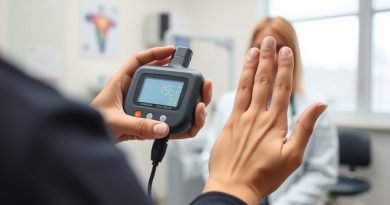
New Physics-Based Model Tracks Vocal Fold Fatigue in Real Time
For professionals who rely heavily on their voices for daily work, such as teachers, public speakers, call center operators, and vocalists, vocal strain is an occupational hazard. A new scientific study published in the International Journal of Information and Communication Technology introduces an innovative mathematical model designed to track vocal fold fatigue as it actively develops. By understanding how the vocal mechanism tires and recovers, researchers hope to pave the way for better monitoring tools and personalized voice-care strategies.
Understanding Vocal Fold Fatigue
The vocal folds, commonly known as vocal cords, are specialized vibrating muscular structures situated inside the larynx at the top of the trachea. They enable humans to speak, sing, and produce a wide range of vocal sounds. However, prolonged or intensive use can lead to vocal fold fatigue. This condition is characterized by declining vocal efficiency, a noticeable drop in voice quality, and the need for significantly greater physical effort when speaking. While anyone can experience tired vocal tissues, it is exceptionally common among individuals whose occupations demand sustained, high-volume, or continuous voice use.
A Dynamic Physics-Informed Approach
Traditionally, vocal strain has been evaluated as a static condition rather than a fluid, ongoing physiological process. To address this limitation, researchers developed a novel framework called physics-informed joint simulation and identification (PJSF). Rather than looking at a single snapshot in time, this model treats vocal fatigue as a continuously evolving process involving the constant depletion and recovery of the vocal system. The framework utilizes specialized mathematical equations to simulate how the vocal apparatus changes over time during prolonged use.
To make accurate assessments, the PJSF model integrates two primary data streams: acoustic recordings of the voice and laryngovibrography, which measures the physical vibration patterns of the vocal folds. By combining physics-based equations with real-world physiological measurements, the system can effectively evaluate a user’s current vocal status and even predict potential issues before they escalate into more severe voice disorders.
Promising Results and Future Applications
During initial testing involving 20 human volunteers, the research team evaluated how well the framework performed in real-world scenarios. The results showed that the system successfully balanced the accurate identification of actual vocal fatigue while minimizing false alarms, ensuring reliable assessments. Authors of the study note that this foundational work could eventually lead to advanced monitoring systems capable of tracking vocal strain continuously throughout a workday. Ultimately, such technology could support tailored, personalized guidance for professionals who depend on constant voice use, helping them preserve their vocal health and prevent long-term injury.
- Tracks vocal fatigue as a continuous process rather than a fixed state
- Combines acoustic recordings with laryngovibrography measurements
- Tested successfully on 20 volunteers with minimal false alarms
- Aims to support personalized vocal-care guidance for heavy voice users
Source: Medical Xpress